Italiano
 Deutsch
Passo Val Cervia, passo Dordona

A spectacular, scenic, and very well-rounded ride, featuring an ascent that’s mostly rideable on an e-MTB and a long stretch of technical trails leading from the Valcervia Pass to the Dordona Pass, Foppolo, and finally back to Valleve. It’s not an extreme ride, but it does require good riding technique. The descent consists mainly of S3-level difficulty, with a short S4 section in the upper part and a very physically demanding and technical section from Passo Dordona. Additionally, before reaching Valcervia, you’ll need to factor in about 100–120 m of elevation gain involving pushing or carrying your bike, with a couple of spots where you’ll have to shoulder it. Even on an e-MTB, it remains a very interesting ride and is well within the capabilities of a skilled rider accustomed to mountain trails.
Valleve - Foppolo
The route starts in Valleve and climbs gently on paved road toward Foppolo.
The first part is mainly for gaining elevation and presents no technical difficulties.
From Foppolo, you continue on paved road, initially following the route that climbs toward Passo Dordona until the trail veers onto the mule track.
From here, the climb changes completely.
Ascent toward Valcervia
Once you leave the paved road, you’ll tackle a very challenging mule trail, with steep gradients and a surface that requires good technique.
With an e-MTB and good riding skills, it’s generally rideable, while on a standard MTB, several sections become quite difficult and may require you to push the bike.
You continue to gain elevation until you reach the area of the lakes below the Valcervia Pass.
This is where the rideable section ends.
Last 100–120 m toward the Valcervia Pass: CARRY
To reach the Valcervia Pass, you’ll need to account for about 100–120 meters of elevation gain on foot.
The trail isn’t particularly steep, and for the most part, you can simply push your bike.
However, there are a couple of sections where you’ll need to carry your bike on your shoulder to get through them comfortably.
It’s not a long or mountaineering-style portage, but it should be taken into account before setting out, especially with an e-MTB: you need to be physically capable of handling the bike’s weight while off the saddle.
Once you’ve passed this short stretch, you’ll reach the Valcervia Pass, and the long downhill section finally begins.
Valcervia Pass – first section S4
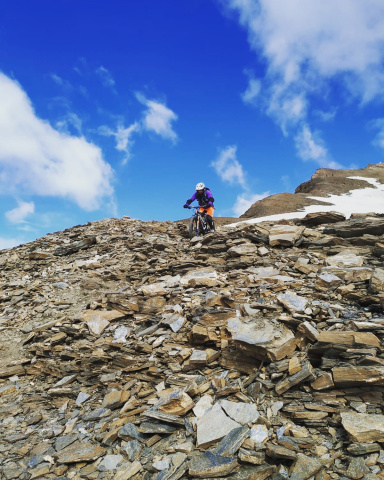
The descent from the pass is the most technically challenging part of the upper section.
The first few meters feature some S4 sections, including a bit of exposure.
However, it’s important to assess them correctly: this is a very short section —less than about 50 meters—and not a long S4 descent.
Those who don’t feel up to it can safely tackle these sections on foot.
Once past this first section, the difficulty and exposure decrease significantly.
Valcervia – Lakes – Casera: S3
From here begins one of the most beautiful parts of the entire route.
The descent continues through a very open and scenic landscape, passing through the lake area.
The difficulty level is mostly S3, and the significant exposure disappears.
The trail remains technical and requires active navigation, but without the severity of the first few meters from the pass.
Continue in this manner until you reach the Casera area.
Casera – traverse toward Passo Dordona
From the Casera, the route changes character once again.
You enter a long traverse with a base difficulty of aroundS2, but this should not be interpreted as an easy stretch.
There are numerous sections where you have to push off, short climbs, and several rocky passages that constantly break up your rhythm.
Individually, they aren’t particularly difficult, but taken together, they make this section physically demanding, especially on a muscle-powered MTB.
You constantly have to push the bike and clear small obstacles, so you continue to expend a lot of energy even though you’re no longer tackling a real climb.
The traverse finally leads to the Dordona Pass, where you’ll also find the remains of fortifications and military trenches.
Dordona Pass – Foppolo
From Passo Dordona begins the section of the descent that requires the most technical consistency.
It’s a very beautiful, physically demanding, and technical trail, mostly on fairly stable rocky terrain.
The difficulty ranges from S3 to S4, with numerous sections that require you to actively steer the bike.
This is no longer a matter of just a few isolated obstacles.
This is a descent where you need to have good control of your MTB on technical trails to maintain a steady flow and, above all, to have fun.
Riders who are at their limit on S3 risk having to stop frequently during the descent and tackle several sections on foot.
For those accustomed to technical S3 sections with S4 passages, however, this is probably one of the most beautiful sections of the entire ride.
The generally solid rock helps a lot when choosing lines.
The route continues like this until you return to the Foppolo area.

Foppolo – Valleve
Once you reach Foppolo, the final descent to Valleve still lies ahead.
And it would be a shame to end the ride on asphalt.
So take the beautiful trail through the woods that descends directly toward Valleve.
It’s a very varied descent, with practically a little bit of everything: fast sections, roots, rock, curves, and more technical sections.
In terms of overall difficulty, I’d rate it as a moderate S3.
It doesn’t quite match the technical consistency of the descent from Dordona, but it’s still a true MTB descent—not just a simple return trail.
It’s a great way to finish the ride, taking you straight to Valleve and completing the loop.
Variant from San Simone
If you want to extend the ride further, you can climb toward San Simone and also join the descent coming from Passo di Tartano.
However, this variant significantly increases the distance, elevation gain, and overall difficulty and should therefore be evaluated separately from the loop described here.
Be Aware of the Difficulties
This route can be tackled by many riders with solid all-mountain experience, but it’s important to know what to expect:
- 100–120 m of actual elevation gain on foot before the Valcervia Pass, mostly pushing the bike but with a couple of sections where you’ll have to carry it.
- A very short initial S4 section from Valcervia, less than fifty meters, with a few exposed points.
- This is followed by a scenic S3 section that isn’t particularly exposed all the way to the Casera.
- The traverse toward Dordona is technically easier—about S2—but tiring due to the constant need to push the bike forward and some rocky obstacles.
- Dordona Pass to Foppolo: S3/S4, long, physically demanding, and technical—this is the section where consistent riding is most important.
- Foppolo to Valleve: moderate S3, fun, and very varied.
The most difficult sections can, of course, be navigated on foot, but those who aren’t normally comfortable on S3 trails should keep in mind that, especially on the descent from Dordona, you may need to dismount frequently.
Technical Details
Trail style: AM
Elevation gain: approximately 1,400 m D+
Duration: about 3–4 hours (on an e-MTB)
MTB: Yes, but some sections of the climb are very challenging
E-MTB: Yes, particularly suitable
Rideability with E-MTB: Very high up to the lake area
Portage: approximately 100–120 m elevation gain, with a couple of short sections requiring carrying the bike
E-MTB Ascent Difficulty: Almost entirely rideable with good technique, except for the final portage to Valcervia
MTB climb difficulty: Several very challenging sections that are difficult to ride
Valcervia, first few meters: S4, short with a few exposed sections
Valcervia–Casera: mostly S3
Casera – Dordona: mostly S2, but physically demanding due to the constant climbs
Dordona to Foppolo: S3/S4, technical and physically demanding
Foppolo – Valleve: Moderate S3
Exposure: A few short exposed sections at the start from Valcervia; can be bypassed on foot
Drainage: Seems good, but difficulties can increase significantly on wet rock
Water sources: Valleve and Foppolo; it’s best to start with a good supply anyway
Physical demand: Moderate to high
Technical difficulty: Medium-high, concentrated mainly on the descent from Passo Dordona