Italiano
 Deutsch
Monte Salvaro e Monte Radicchio: i due versanti del Reno
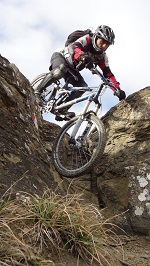
Two mountains, two sides of the Rhine Valley, and a series of trails that alternate between flowing sections, technical passages, and decidedly challenging stretches. The route starts in Calvenzano and winds its way between Monte Salvaro and Monte Radicchio, linking together historic descents in the area, rocky sections, and trial-style passages. A complete loop where the climb demands leg strength (even on an e-bike), and—especially in the second half—the descents put your technique and riding precision to the test. From Calvenzano to the summit of Monte Salvaro. Start from the parking lot at the little church in Calvenzano, taking the provincial road (SP) to the left. Once you reach the bridge over the Reno River, turn left again toward the village of Salvaro, tackling a gradual climb on paved road. Continue toward Querceto: the gradient generally remains rideable, but there are a few fairly steep sections. Shortly after passing the intersection with the road coming from Monte Sole, take CAI Trail 100 on the right, which climbs toward Monte Salvaro.
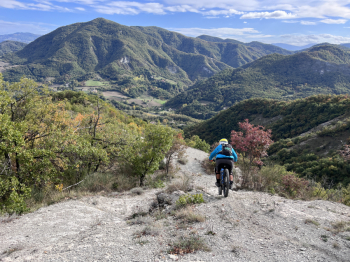
The climb alternates between challenging sections and gentler stretches, but on an e-bike, it’s 100% rideable. Once you reach the Bue Morto curve, turn left and take the trail (just past it on the left) that continues to climb, alternating between a few more steep sections and more even stretches, until you arrive just below the summit of Monte Salvaro. Here, keep left on the downhill trail, leaving it shortly afterward to follow—still to the left—a ridge trail marked by red blazes. This is the start of a beautiful trail: smooth in the first part, it gradually becomes more technical in the second, with small rocks, steps, and a few steep sections. The difficulty reaches S2/S3 level, with slight exposure on the left side. The trail ends at a trail junction, where you keep to the left. The descent continues along a smooth trail, interrupted by a few more technical sections in the final stretch, rated S2.
Once you reach the paved road, turn right and pass through the village of Poggio. After passing Ca’ Benassi, at a left-hand hairpin turn, take the dirt road on the right. The climb features a few steep sections, but overall the gradient is gradual, allowing you to return toward Monte Salvaro, this time reaching the summit cross directly. Ca’ degli Schiavi: rock, steps, and exposed sections. From the cross, take the CAI 100 trail, which descends steeply toward the Bue Morto hairpin turn. The trail is classified as S2 and requires careful management of the slope and speed. Once you reach the hairpin turn, turn left and enter the Ca’ degli Schiavi trail. The first section is smooth and invites you to let the bike roll, but the trail’s character changes rapidly. The most technical part features exposure on the left side, rock steps and sections of loose rocks, narrow passages on dirt and rock, and a few steep sections that require precision in choosing your line.
The descent alternates between controlled sections and more challenging passages, until you return to Salvaro. From here, you’ll ride a short paved stretch, followed by a few sections of bike path that lead back to the Porrettana. Turn left toward Tabina, and once you reach the village, turn right to begin the climb toward Monte Radicchio. Monte Radicchio and the Torcole Trail. You’ll pass through the hamlet of Lastre and tackle some tough climbs on asphalt before continuing on a dirt road. Once you reach the hairpin turn, continue straight ahead onto the trail that leads into the woods. The average gradient is manageable, though there are a few more challenging sections. The dirt surface, however, makes the climb quite challenging: rideability is good only when the ground isn’t too wet. Continue climbing until you reach the Monte Radicchio junction, where the classic Torcole trail branches off to the right. After a short climb over the ridge, the trail immediately gets intense with a challenging descent over rock and gravel. Steps and sections bordering on trial-style riding raise the difficulty to S3, requiring control, precision, and a good ability to read the terrain. The descent continues until it reaches a ditch. After a few guided sections with steps, you enter the most distinctive part of the route: the canyon.
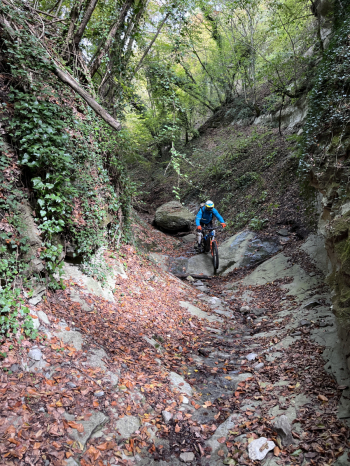
Here, you follow the riverbed of a dry stream, which over time has carved out a long passage through the rocks. Rideability is good if you choose the alternative trails that run along the edges of the riverbed, but the terrain remains varied and full of obstacles. The route alternates between sections over small rocks and boulders, tight slalom sections inside the canyon, a few puddles, and smoother stretches where you can pick up speed. This is a distinctive stretch that requires constant attention when choosing lines and precise riding to make the most of the available options. Once you reach the dirt road, keep left and descend toward Laste. Razorback: the final stretch is still all about riding. From Laste, take the small road on the left to climb back up toward Collina. The climb follows a dirt road and unpaved terrain, with a gradual slope that allows you to catch your breath after the challenges of the Torcole.
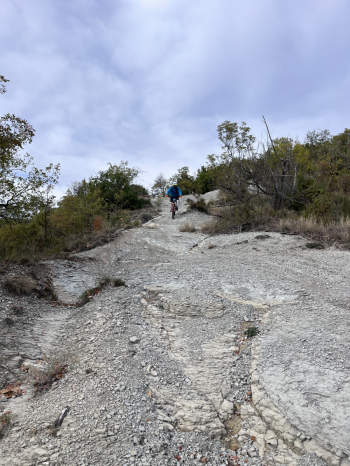
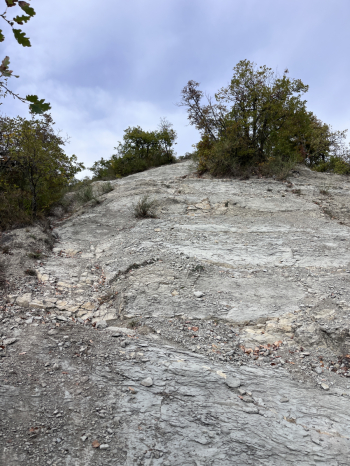
At the ruined house, turn right onto the final trail: Razorback, another classic in the area. The start is immediately challenging, with a steep section over rock and loose gravel, followed by a few large steps. Then comes a beautiful sequence of narrow, technical sections among boulders, steps, and exposed rocks, rated S2/S3. The descent continues with a mix of steep sections and hairpin turns on dirt, but the trail’s character gradually becomes smoother and more flowing. The finish is fast: a forest road leads to Calvenzano, from where it takes just a few minutes to return to the parking lot by the little church and complete the loop.
A varied and technical route that combines the descents of Monte Salvaro and Monte Radicchio into a single ride. From flowing stretches to the most challenging rocky sections, passing through the Torcole Canyon and the Razorback finale, the route offers a succession of terrains and difficulties that require attention and the ability to adapt your riding style. With an e-bike, the climbs become more manageable, but on the descents, the mountain takes its toll: here, technique, line choice, and bike control really make all the difference.